The software industry is currently hypnotized by four numbers:
- bigger context windows - more tokens - darker software factories - tighter agent loops
That makes for good demos. It does not necessarily make for good companies.
No CEO has ever walked into a board meeting and asked, "How many tokens did we consume this quarter?" They ask a much harder question: **how much value did we create?**
That distinction matters because the economics of AI engineering are changing fast. Models are improving. Inference is getting cheaper. Agents are becoming easier to spin up, easier to parallelize, and easier to point at a codebase. Execution is becoming abundant.
When execution becomes abundant, the bottleneck moves.
It moves away from raw token consumption and toward outcomes. It moves away from the model itself and toward coordination. It moves away from generating code and toward deciding what should be built, why it matters, and which agent should be trusted to do it.
That is the part many teams still underestimate.
## The hype cycle is optimizing the visible layer
Look across the incumbent landscape and you see the same pattern.
**Claude Code** is pushing deeper autonomous terminal workflows. **Cursor** and **Windsurf** are racing on faster agent-assisted implementation loops. **GitHub Copilot** keeps improving the interface between prompt, editor, and task execution. **Devin** and the broader "dark factory" narrative are selling a future where entire software streams run with minimal human intervention.
None of these bets are irrational. They are each useful parts of the stack.
But they are mostly optimizing the visible layer of autonomy: how fast an individual agent can do work once it has been given a mission.
The harder question sits above that layer:
Who defines the mission?
Who checks whether two agents are solving the same problem twice?
Who preserves the institutional memory that explains why an earlier path was rejected?
Who notices when an agent is optimizing for local completion while damaging system-wide outcomes?
That is where "more context" starts to look like the wrong metric.
## Bigger context windows are not the same thing as shared memory
People often treat context as if it were a universal solvent. If an agent makes a mistake, the answer must be to give it more files, more chat history, more repository dump, more tokens.
Sometimes that helps. Often it just makes the failure more expensive.
There is a difference between:
- **more context** - **better memory** - **better coordination**
Context is what an agent can currently see. Memory is what the system can reliably preserve. Coordination is how multiple actors avoid working at cross purposes.
Those are not interchangeable.
flowchart TD
  A[Cheaper models and more agents] --> B[Execution becomes abundant]
  B --> C[More parallel work enters the system]
  C --> D{Coordination layer exists?}
  D -- No --> E[Duplicate work, drift, wasted tokens, unclear ROI]
  D -- Yes --> F[Shared intent, durable memory, outcome tracking]
  F --> G[Higher business value per agent]
If ten agents can all write code, the scarce resource is no longer typing. The scarce resource is **alignment**.
## The dark factory dream has a blind spot
The phrase "dark software factory" sounds thrilling because it borrows the emotional energy of industrial automation: lights off, machines humming, output compounding.
But software is not a warehouse and AI agents are not CNC machines.
Autonomous software work has a unique failure mode: agents can appear productive while quietly diverging from business intent.
A dark factory with 100 agents raises questions that matter more than the count itself:
- How do those agents coordinate changes across shared systems? - How do they preserve organizational memory after a model session ends? - How do they avoid redundant implementation on the same outcome? - How do they prioritize business leverage instead of local token efficiency?
If you cannot answer those questions, then a 100-agent factory is just a faster way to produce confusion.
## The next frontier is outcome orchestration
The winning companies in agentic engineering will not be the ones that merely run the most tokens. They will be the ones that can turn autonomous work into governed, compounding business output.
That requires a control plane.
Not a control plane in the cloud-infrastructure sense. A control plane for **agentic software development**:
- intent before execution - memory that survives sessions - coordination before duplicate work starts - review before bad work becomes canonical - evidence that connects engineering activity to business value
This is the missing layer between "agent can write code" and "organization can rely on fleets of agents."
flowchart LR
  I[Business intent] --> T[Task and owner selection]
  T --> M[Shared memory and prior findings]
  M --> A[Agent execution]
  A --> R[Review and policy gates]
  R --> O[Measured outcome]
  O --> L[Organizational learning]
  L --> I
Notice what is absent from that diagram: token count as the governing objective.
Tokens matter operationally. They do not define value strategically.
## The companies that win will look boring from the outside
This is usually how real platform shifts work.
The market gets excited about the visible magic first: flashy demos, giant context windows, agents completing tickets, autonomous pull requests, loops that look infinite. Then, once the novelty fades, the advantage accrues to the organizations that solved the boring coordination problems underneath.
The winners will have systems that can answer questions like:
- Which agent worked on this outcome? - What prior reasoning did it inherit? - What overlap was avoided? - Which changes were rejected and why? - Which autonomous work actually moved the business forward?
That is not anti-agent. It is what mature agent adoption looks like.
## This is why we are building Nool
We believe the future belongs to organizations that can coordinate autonomous work at scale.
That is why we are building **Nool**: the control plane for agentic software development.
Nool is built around a simple conviction: once agents become cheap and plentiful, the real advantage comes from governing how work is coordinated, remembered, reviewed, and measured.
That is why we care about:
- preserving operational memory across sessions - preventing duplicate work before it starts - binding implementation to intent - measuring outcomes instead of worshipping token burn
The question is no longer whether every engineer will have a team of AI agents.
That future is already arriving.
The real question is what becomes the bottleneck **after** that happens.
Our answer is clear: not context windows, not raw model intelligence, and not token supply.
The bottleneck will be **coordination**.
And the teams that solve coordination first will outperform the teams still optimizing for demos.
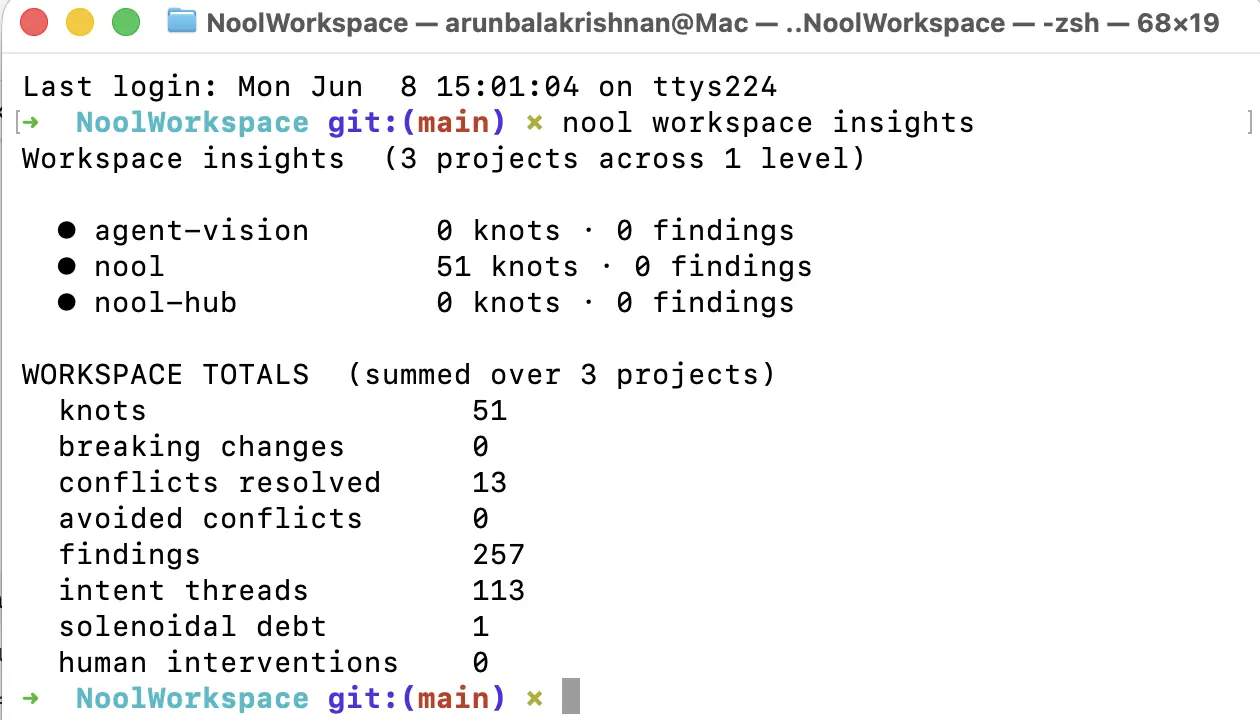 *When agentic engineering matures, leadership stops asking how many tokens were spent and starts asking which outcomes compounded.*
What do you think the bottleneck will be when every engineer has a team of AI agents?